
When a U.S. President Tried using to Modify Thanksgiving
[ad_1]
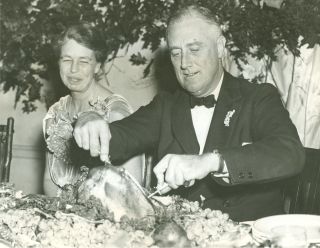
Eleanor Roosevelt watches as the President operates on the massive turkey, setting in movement the yearly Thanksgiving feast at Heat Springs, Georgia. November 29, 1935.
Resource: flickr, totally free utilization
What if someone advised you that the governing administration prepared to shift Thanksgiving by a 7 days?
This is what a team of researchers, led by Daniel Stein at the College of California at Berkeley, did: they asked people today in the U.S. how they felt about the possibility of a community vacation currently being altered. Participants were advised to picture that the governing administration experienced resolved to “shift celebrations for the holiday a single week ahead.” In truth, this is not unheard of.
In 1939, President Delano Roosevelt was striving to uncover ways to increase a U.S. financial state that was still recovering from the Excellent Depression. That yr, Thanksgiving fell on the last day of the thirty day period, November 30, producing a rather limited vacation period. Apprehensive that Individuals wouldn’t start out their vacation browsing until finally following that day, company lobbyists floated the strategy of relocating Thanksgiving a 7 days previously, to November 23, so that buyers would shell out extra funds all through the extended browsing year. Right after all, what could be far more American than this sort of a market-driven method? Convinced by this argument, Roosevelt issued an govt proclamation asserting the alter on August 15. Then all hell broke unfastened.
The choice instantly caused an uproar. The vast majority of People strongly disapproved of the adjust, and Roosevelt’s political opponents went as considerably as evaluating him to Hitler. When November arrived, most states refused to implement the purchase, and the country experienced a split Thanksgiving: the new official but substantially maligned one, which speedily turned derisively known as Franksgiving, and the time-honored alternate, occurring on the original date. Some states selected to celebrate equally.
The schism ongoing for two decades right up until Rosevelt capitulated. In 1941, a joint resolution was signed, setting Thanksgiving as the fourth Thursday in November, where by it remains to this day.
Nearly a century later on, individuals in the Stein experiment expressed similar condemnation at the imagined of these types of alterations. But not all holiday seasons had been equal. Whether religious or secular, vacations associated with rituals—for illustration, Christmas, Thanksgiving, and New Year’s Day—elicited about 2 times as much outrage as less ritualized holiday seasons these as Columbus Working day, Labor Working day, or George Washington’s birthday. Folks did not simply locate these alterations bothersome or inconvenient they judged them to be morally appalling.
Further more research and measures by the exact researchers confirmed that even slight alterations, this sort of as transforming a one ingredient of a sacred meal, had been ample to elicit condemnation, even to the position exactly where individuals had been inspired to punish other customers of their in-group for failing to uphold the group’s ritual traditions. For instance, fraternity members reported that it was incorrect to neglect group rituals this sort of as expressing the Creed or reciting the founders’ names, and they expressed anger and stress at new users who skipped them. On the other hand, they did not experience as upset at violations of considerably less ritualistic traditions, these types of as missing registration day or analyze several hours. When they ranked individuals gatherings in phrases of how ritualized they were—for instance, how a lot repetition, redundancy, and rigidity they involved—the researchers located that the rankings corresponded to participants’ moral judgments: the much more ritualized the party, the much more upsetting persons identified its omission.
Alterations to group rituals provoke moral indignation simply because they are perceived as an affront to sacred group values. By definition, rituals have no intrinsic meaning—they contain arbitrary steps that have no direct causal outcomes. This lets them to come to be autos for communicating and reinforcing any values endorsed by the group. Somewhat than mere representations of people values, they develop into their pretty embodiment. From a rational standpoint, they might look senseless, but the psychology of ritual reveals that across all societies, they are deeply meaningful.
[ad_2]
Resource website link