

The Misunderstood ADHD Struggles | Psychology Currently
[ad_1]

Source: Suzanne Tucker/Shutterstock
Tommy sat at his desk and he opened his notebook. The essay recommendations have been on the monitor, and he dutifully commenced to browse. However, immediately after just a several minutes, his consideration drifted, lured away by the intricate spider world-wide-web that adorned the entry doorway. Tommy turned frustrated as he understood that he couldn’t remember a single word he’d just go through. He created an work to refocus, but his mind proved elusive, slipping away after much more.
This scenario was all as well acquainted to Tommy. Each and every time he attempted to tackle his research, it appeared like an uphill fight. His good friends simply breezed through assignments, while Tommy located himself wrestling with his wandering ideas, continuously veering off class.
At the age of 13, Tommy received a analysis that get rid of light-weight on his struggles: Attention Deficit and Hyperactivity Problem (ADHD). It was a revelation that carried the two reduction and sadness. Ultimately, he understood that his incapability to concentrate was not a character flaw, and he wasn’t merely “lazy,” as his mom and dad and academics had sometimes accused him of becoming.
But although the diagnosis supplied clarity, it failed to give a magical answer. Tommy’s intellect remained a restless wanderer, constantly venturing down rabbit holes of distraction. Irrespective of understanding the root bring about of his troubles, the problem of handling his concentrate persisted, leaving him to grapple with his have head, just one essay at a time.
Exploration into the neural mechanisms underlying ADHD has unveiled an intriguing point of view. It implies that ADHD is not mostly characterised by abnormalities within distinct regions of the mind but is instead a condition rooted in disruptions of purposeful connectivity.
A pivotal participant in this connectivity conundrum is the default method network (DMN). This community springs to life when individuals are in a point out of relaxation and not actively engaged in cognitive jobs, like, for occasion, tackling research. Conversely, when we change our focus to cognitive duties, specialised endeavor-relevant networks kick into equipment to support us comprehensive the task at hand. In individuals devoid of ADHD, there exists a delicate equilibrium concerning the DMN and these task-relevant networks. When one community gets additional energetic, the other tends to peaceful down, producing a seamless changeover in between resting and cognitive engagement.
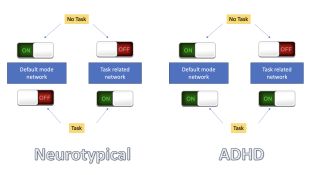
Dysfunction of the DMN in ADHD
Source: Isabelle Brocas
However, for men and women with ADHD, the DMN doesn’t obediently retreat all through cognitive responsibilities. Instead, it persists, stubbornly retaining its action. This unconventional actions within the DMN is involved with the intrusion of unrelated thoughts or daydreams for the duration of these tasks. It really is as if there is certainly an ongoing tug-of-war in the mind concerning the DMN and the cognitive calls for of the second.
This neurological struggle gives an illuminating explanation for why individuals with ADHD frequently working experience a consistent, magnetic pull absent from their recent process, easily succumbing to distractions. It is not a mere absence of willpower it’s a neurological dance involving two competing networks that will make focusing on a single process nearly not possible. Compared with commonly establishing children, who typically outgrow these problems as they experienced, folks with ADHD normally go on to wrestle with these worries all through their lives. This enduring battle can final result in understanding impediments and complications in social conversation.
In modern a long time, there has been a obvious enhance in the prognosis of ADHD in the United States. Somewhere around 9.4% of small children aged 4-17 are afflicted, with boys extra generally diagnosed than girls. Also, about 4.4% of older people in the US are considered to have ADHD, despite the fact that this selection might be underestimated.
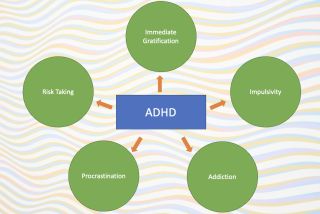
ADHD and choice-producing
Resource: Isabelle Brocas
A person region wherever the effects of ADHD will become apparent is conclusion-producing. Conclusion-creating is closely intertwined with cognitive skills, as it will involve assessing various solutions and deciding upon the most favorable one. Folks with ADHD normally show variances in their selection-earning types as opposed to neurotypical people today, especially in conclusions involving possibility and the thought of long term consequences. This inclination towards threat-getting generally persists into adolescence and adulthood, foremost to behaviors this kind of as delinquency and substance abuse.
Raising a baby with ADHD like Tommy can be a complicated journey for mother and father. Comprehending what their little one is going through, which includes problems in concentrating, daydreaming, procrastination, non-compliance with recommendations, and restlessness, can be perplexing. It really is important for dad and mom to figure out that these behaviors are not intentional kids with ADHD need their parents’ endurance and knowing. Residing with ADHD can be an exceptionally disheartening working experience. Persons generally acknowledge that their steps are suboptimal, nevertheless they truly feel powerless and incapable of altering them. Additionally, they grapple with the challenge of getting misunderstood, as it is really complicated to express their experiences to people who you should not share the issue. By approaching ADHD with empathy and knowledge, we can make a significant variation in the lives of people influenced by this affliction, supporting them navigate their one of a kind paths to good results and well-staying.
[ad_2]
Supply url