Our Four Realms of Existence
[ad_1]
This put up is Element 1 of a series.
Several of us understand that the mental component of who we are is embedded in the component of the entire body known as the mind, and consequently is also portion of our physical, bodily existence. However, even legitimate believers of the actual physical nature of the brain from time to time experience as although it possesses some high quality or attributes lacking in other physical techniques in just our human body, and even within just our mind.
We have firsthand awareness of the psychological states we refer to as perceptions, recollections, views, and emotions, but absence awareness of procedures in the mind that regulate digestion, respiration, heart rhythm, and substantially of our behavior. What is it about the mental things that would make it appear to be distinctive from the relaxation of the bodily stuff that constitutes who and what we are?
Just as your head is dependent on your brain, your mind, being part of your overall body, relies upon on the life-sustaining capabilities of other components of your body. If your coronary heart stops beating, or your lungs collapse, all your other organs, together with your brain, will quickly stop to function in a way that is appropriate with everyday living. Without the need of bodily life, there is no brain perform, and without having brain functionality, no mind.
How, then, out of all this organic physicality, do we just about every come to exist as a remaining that is familiar with it was born in the past, is familiar with that exists now, and appreciates that it will someday die?
Self and Temperament Are Not the Remedy
The common solution to these types of queries about individuality is to focus on psychological notions like the self or identity. These have lengthy guided philosophical musings, as properly as scientific theories and research, about what it is to be a human staying. But there is tiny arrangement about what self and identity refer to, and even whether or not they refer to genuine entities, as opposed to just staying shorthand labels for a wide range of psychologically fascinating phenomena.
Here’s what students from the past and present have experienced to say about “the self”:
- David Hume (philosopher): The elusive “I.”
- Shaun Gallagher (philosopher): Inspite of the consolation stage of the discipline to communicate about the “the self,” what is explained is normally controversial.
- Daniel Dennett (philosopher): The “self” is an illusion.
- Thomas Metzinger (philosopher): No one at any time experienced or was a self.
- Owen Flanagan (thinker): Just because “self” is in our vocabulary does not signify that it has any explanatory role.
- Joseph LeDoux: Your Self is not a detail. It is a tale you generate about who you are.
Equivalent concerns have been lifted about identity:
- Harry Stack Sullivan (personality psychologist): Temperament is an illusion.
- Walter Michel (individuality psychologist): Identity is a fantasy.
Scientific discoveries over the final various a long time from numerous fields, these kinds of as neuroscience, genetics, and synthetic intelligence, have led to new thoughts about how human beings exist as actual physical units. These findings, in complicated cherished assumptions about human character, have resulted in an epistemological vacuum. In no tiny component, this is simply because imagining about “who and what we are” has not innovative appreciably further than traditional thoughts, some put forth in ancient times.
The many phenomena that have been uncovered when finding out self and individuality have, without the need of question, offered vital insights into human nature. But what if it is our scientific comprehension of who and what we are that is baffled? Especially, what if our constructs are inadequate as conceptual hooks on which to dangle the empirical conclusions that have been identified in their identify? Simply because these generations-outdated notions obscure as much as they expose, the phenomena could be far better served by a new conceptual home, a person grounded in modern scientific conceptions and empirical investigate.
Our Realms of Existence
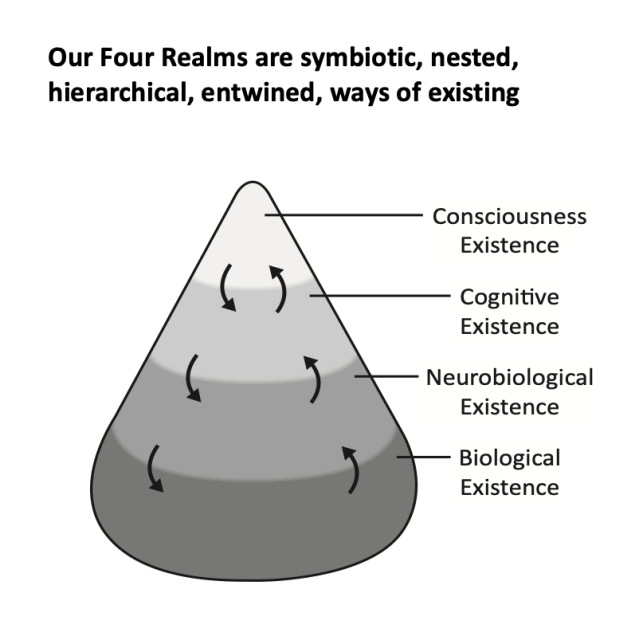
A human staying can be characterised as a composite of 4 elementary, parallel, entwined realms of existence that replicate our evolutionary previous and account for our present ways of being. These are: biological, neurobiological, cognitive, and conscious. All 4 are, deep down, biological. But the neurobiological realm transcends the mere biological, the cognitive transcends the mere neurobiological, and the mindful transcends the mere cognitive.
The 4 realms coalesce as an “ensemble of being.” Collectively, the four realms, and the resulting ensemble, account for what and who we are, such as individuals aspects of us that tumble underneath the rubrics of the self and character.
The 4 realms framework is not an physical exercise in reductionism, exactly where increased psychological strategies of becoming are described in neurobiological conditions, neurobiological techniques in phrases of organic, and organic in terms of chemistry and physics. It is alternatively about how symbiotic interactions between the stages sustain the in general existence of the human organism.
Consciousness Crucial Reads
Joseph LeDoux, The Four Realms of Existence.
Just about every realm anatomically permeates and physiologically enables the level previously mentioned it, and at the same time, the survival potential of the stage beneath is enhanced by the a single earlier mentioned. The realms considerably resemble elements of a Russian doll. But not like a Russian doll, in which the parts simply stack on prime of a single an additional, our part realms are conjoined, built-in, and interdependent. Every thing about an particular person human currently being, biologically and psychologically (including all of what falls underneath “self” and “persona”), is subsumed in just the entwined, nested, hierarchical, corporation of our realms of existence.
It’s comparatively effortless to different biological beings from non-living subject. If a little something is alive, it is a biological becoming. Determining which organic beings exist neurobiologically is also fairly straightforward. If an organism has a nervous procedure, it is a neurobiological staying and, by definition, it exists neurobiologically. That narrows items down to animals, or at the very least most animals.
When it arrives to the cognitive and conscious realms, things are noticeably extra complicated since there are no equal actual physical qualities that unequivocally recognize which organisms are cognitive and aware beings. As a final result, we have to rely on behavioral standards. That can be challenging considering the fact that distinct experts outline cognition and consciousness otherwise.
Having said that, my primary purpose is not to offer you an account that animals are cognitive and/or mindful. There are a lot of strategies, and controversy, about that floating close to. Instead, what I have experimented with to do is to account how our 4 realms interact, and in so executing, make us human beings what and who we are.
In the up coming numerous posts I will unpack the biological, neurobiological, cognitive, and acutely aware realms of human existence.
[ad_2]
Source backlink