

Most cancers-phobia: How Our Concern of Most cancers Harms Us
[ad_1]
This is the 3rd in a sequence of posts based on my new guide Curing Cancer-phobia: How Danger, Anxiety, and Get worried Mislead Us.
We fear cancer for superior rationale. It is a big trigger of dying and can be an dreadful way to die. But we also need to acknowledge that in some techniques our deep, reflexive fear of “the C-word” exceeds the precise risk and finishes up undertaking significant damage to each our personal health and modern society in basic.
In phrases of health and fitness destruction, things begin with cancer screening. In the U.S., four styles of cancer screening have been located to be “effective” (defined by the National Most cancers Institute as cutting down the amount of individuals who die, and providing much more advantage than damage) for asymptomatic individuals with no other chance factors, like genetics. These are mammography, cervical most cancers “Pap smears” and human papillomavirus (HPV) assessments, special CAT scans for lung most cancers, and many kinds of colorectal screening. But even these are only proposed for certain men and women and at specified frequencies, based on who is much more probable to be aided than harmed.
Still tens of millions of men and women outside of all those groups seek out the reassurance of screening against their fear of cancer—people whom research has found are extra possible to be harmed than served.
- In 2017, when mammography was advisable after each individual other year for girls amongst 50 and 74, 15.6 million gals underneath 50 and 5.7 million in excess of 74 explained they’d experienced one particular at some time in the earlier 10 a long time.
- Colorectal most cancers screening was proposed for persons from 50 to 75, nevertheless 251,000 persons down below 50 and 1.1 million above 75 screened in any case.
- The PSA check for prostate cancer is just not frequently proposed at all, for the reason that its harms outweigh its rewards, but it is encouraged that guys between 50 and 75 communicate to their medical professionals about possessing a examination. In 2017, 3.9 million adult men underneath 50 and 6.2 about 75 had a PSA examination in any case.
This “overscreening,” mainly pushed by our anxiety of cancer, provides to the all round harm that screening, like for those people in the advisable age teams, results in. First, there are the untrue positives—initial results suggesting the terrifying presence of most cancers that comply with-up exams display had been just untrue alarms. More than 10 a long time of mammography, 1 woman in eight will go by this stressing encounter, which research has uncovered can do long lasting psychological harm. The PSA take a look at is wildly inaccurate. Two-thirds of males who get a terrifying original “You may perhaps have cancer” warning, main to agonizing and risky biopsies (3-4 percent of which guide to hospitalization to address infections), discover out that the scare, which can have long-term emotional outcomes, was a phony alarm.
But phony positives are just the commencing. In excess of the 30-40 years considering the fact that popular cancer screening commenced, we have acquired that quite a few of the early cancers that screening can detect are overdiagnosed they never go on to cause any hurt in the lifetime of the client. It is stunningly contrary to well-liked belief, but some kinds of breast, prostate, thyroid, and even lung most cancers are so small and so slow-increasing that patients with this kind of illnesses die with it, but not from it—and if it weren’t for screening, they would possibly never even know they experienced it.
Not all cancers get rid of. But most sufferers supplied a diagnosis of cancer, even if they are told they have a gradual-growing, lower-chance form that doesn’t have to be removed correct absent and can just be monitored, opt for considerably extra aggressive therapy than their clinical situations demand. They have mastectomies or prostatectomies or thyroidectomies—overtreatments that are a lot more like “fear-ectomies” to remove the disease that frightens them but does not automatically threaten them. These treatments have aspect results that range from moderate to loss of life.
Rough estimates of the damage from these treatment plans produced for Curing Cancer-phobia are sobering, as revealed below:
Yearly Damage from Screening and Procedure of 5 Overdiagnosed Cancers (U.S.)
(as of 2017, just before energetic surveillance/watchful waiting was made available for prostate cancer and before a analysis of reduced-danger thyroid most cancers was re-named to eliminate the phrase “cancer”)
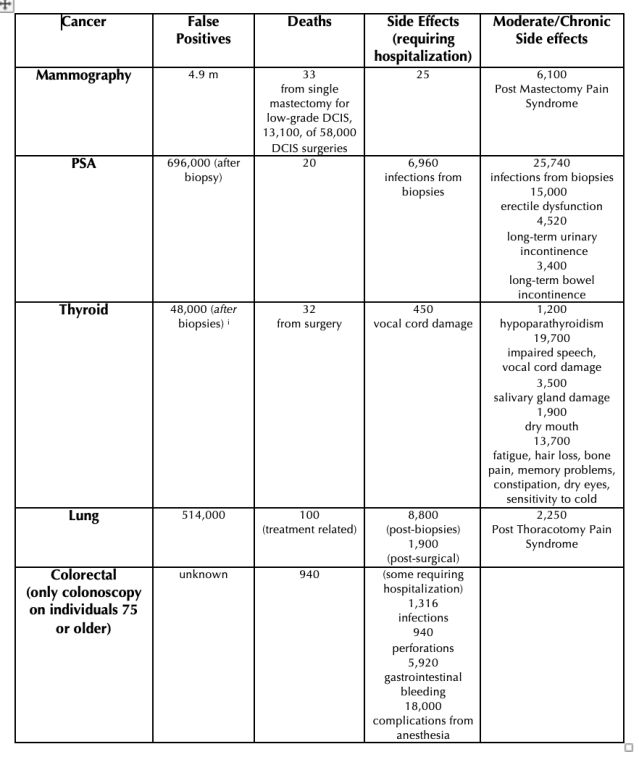
Source: from “Curing Cancer-phobia”
Now let’s consider the impact of all of this not only on unique health and fitness but on the wellness-treatment technique. Overscreening, just on all those outside the house the groups for whom screening is advised, prices the U.S. health care program around $9.2 billion for each 12 months. The overtreatment of overdiagnosed most cancers expenses the program about yet another $5.3 billion a yr. That’s 3 percent of all the funds expended in the U.S. on cancer treatment annually.
And there are however far more economic charges to society. Surgery done on people today with overdiagnosed cancer prices the U.S. economy approximately 1.5 million perform days for each yr, a $1.7 billion price tag to the economic system in missing efficiency.
It’s crucial to qualify that these calculations (described in larger depth in my reserve, Curing Most cancers-phobia: How Danger, Dread, and Get worried Mislead Us), are crude—and purposefully conservative. It is also important to notice, as I respectfully do all over my e book, that these figures glance at issues from the 30,000-foot, inhabitants-as-a-full level, but we make our alternatives about screening and how to deal with diagnoses of reduced-possibility most cancers on our have particular degree, wherever even a person in a million might look as well higher if we could be that a single. The selections any individual will make are theirs and theirs on your own, and not to be judged as appropriate or wrong, smart or unwise.
But looking at the issue at the broader degree, there is no query that our dread of most cancers can in some situations lead to good harm all by itself. And the expenditures to society of that dread extend significantly past those to the health and fitness care program alone.
[ad_2]
Source backlink