
How Rogue Nerves Lead to Migraines, Again Pain, and IBS
[ad_1]
Resource: MattL_Photographs/Shutterstock
What do long-term migraines, again pain, and irritable bowel syndrome have in widespread? These seemingly unrelated conditions share a prevalent fundamental problem—sensitization of the nervous method.
When I was in health care instruction, the several central sensitization syndromes (CSS) ended up referred to and handled independently. They afflicted separate system methods, so the specialist in that physique technique taken care of them. There was no romantic relationship witnessed in between someone with a chronic headache problem and continual again ache. No connection between a person with continual digestive troubles and serious bladder pain. There was no obvious connection among them.
We now have an understanding of the ailments do have a relationship. A link that is pivotal to good therapy.
Sensitization tends to make nerves a lot more sensitive and reactive to stimuli. Additional sensitive nerves mean far more indications, a lot more frequently. CSS also share the same group of danger aspects that guide to their improvement.
How sensitization begins
Very long-phrase stress is a cause for sensitization syndromes. The hormones produced during the tension response swap on an inflammatory state, which will cause irritation in the anxious method. The swelling sensitizes the nerves and will increase the chance of creating a CSS.
In the same way, substantial tension worsens signs. For instance, a previous patient, Bryan, formulated a headache dysfunction throughout an prolonged time period of significant pressure. Bryan’s nervous program was in overdrive for 10 yrs, which sparked serious migraines. His complications returned each time his anxiety concentrations spiked.
Actual physical harm
Another aspect in the progress of sensitization syndromes is actual physical injury. For illustration, Melissa, a prior individual, endured a insignificant back again pressure. About months, sensitization designed, perpetuating the soreness even after the damage experienced healed. A joint injuries is a typical start to sensitization.
As with lots of health care disorders, some folks are genetically predisposed to certain ones. Genetics even have an effect on how you practical experience pain by way of genes specific to agony sensitivity! If you have a reduced soreness tolerance, your genetics might be why.
Psychological elements
Sensitization syndromes often come about along with psychological health circumstances, these types of as depression and stress and anxiety. Each individual a person impacts and worsens the other. The ache problem raises the possibility of depression and stress. Stress and melancholy intensify the suffering from the disorder. A vicious cycle follows. In some cases, long-term back agony triggers despair. Occasionally, despair intensifies back again pain.
The ache and emotion circuits approach soreness collectively, escalating agony notion in the mind. Each and every problem negatively influences the other. It is not that you are “just depressed” or “just anxious” despair and panic raise the agony perception.
Childhood trauma and abuse are common precursors to sure sensitization syndromes. In the clinic, I remember seeing younger ladies existing with entire-system discomfort, fibromyalgia, and serious bladder discomfort. Additional normally than not, these gals endured sexual abuse or trauma as small children, abuse that lasted for a long time.
Abuse may well act as the trigger—the injury—initiating the bodily alterations that lead to sensitization. For illustration, women who have endured sexual abuse typically create chronic agony in the bladder or pelvic location, the location of the abuse. The bodily trauma leads to neighborhood inflammation that influences the nerves, ensuing in neuroinflammation. Psychological trauma and the stress response trigger technique-huge irritation. Neuroinflammation then leads to sensitization and serious agony.
The brain and nervous method turn into vigilant guard canines to preserve absent repeat trauma. The mind is hyper-responsive to any stimuli it fears may well be putting it back again in harm’s way. Trauma receives embedded in the anxious method.
How the discomfort progresses
Here’s how sensitization intensifies discomfort:
- Nerve sensitization is a final result of dysfunction in the nervous procedure.
- Sensitization alterations how suffering indicators are processed and perceived in the mind, spinal wire, and nerves.
- Abnormal processing of indicators final results in enhanced responsiveness to sensory inputs—like contact and movement—as perfectly as amplified reactivity to sensory stimuli, such as light-weight, sound, and smells.
- The greater sensitivity intensifies suffering. Nerves are additional reactive. Discomfort will come on more rapidly and lasts lengthier.
- The ache continues, even in the absence of an personal injury.
Long-term Soreness Essential Reads
The abnormal adjustments in the nervous program from sensitization do not present up on common medical assessments. But, the depth of the distress can make you concerned to transfer or depart the household. Melissa, who formulated persistent back again pain, created a anxiety of moving, fearful the movement would injure her even more.
A nearer seem
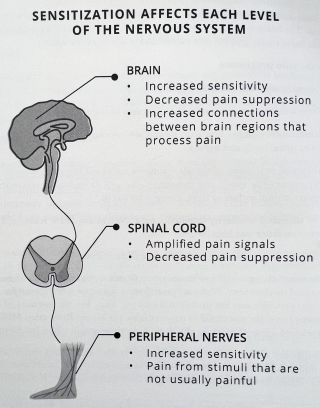
Sensitization develops just after an inciting event—an injury, unrelenting pressure, or trauma—initiates a cascade of swelling that spreads to the anxious program, ensuing in neuroinflammation. Neuroinflammation sensitizes the nerves and disrupts the ordinary processing of ache indicators.
Supply: ‘Sunbreak: Healing the Discomfort No 1 Can Explain’ by Shana Johnson M.D.
Assume of the mind and nerves like an electrical panel. The panel maintains stability in the procedure, changing its inputs and outputs, making an even circulation of signals in the course of the system. Nerve sensitization turns up the sign frequency much too superior, disrupting the function of the method.
The overall body has more intense incoming ache alerts and loses the capability to convert down individuals indicators. The decline of these two crucial processes interprets to much more agony and considerably less defense, which happens at every single level of the anxious procedure.
Functional MRI is a radiology take a look at that shows what parts of the mind are lively all through particular responsibilities, this sort of as finding up objects or sensation agony. It has enabled experts to see how sensitization changes brain operate.
Imaging reveals that those people with sensitization system suffering in another way. They have elevated connections concerning brain locations that course of action discomfort and reduced action in parts that suppress pain. They perceive a lot more agony and have considerably less safety from it.
Base Line
Central sensitization syndromes fluctuate in their signs and symptoms, but they all share the characteristic of nerve sensitization. Sensitization occurs from dysfunction in the nervous procedure. The dysfunction results in much more extreme suffering alerts and reduction of the body’s capacity to change down the suffering indicators. The balance is missing like a malfunctioning electrical panel. These adjustments happen at each and every level of the anxious method, the mind, the spinal wire, and the nerves. Now that useful MRI delivers a visible of mind functionality, we can see how sensitization variations the way the brain processes suffering.
Learn about how to handle sensitization in my e-book, Sunbreak: Healing the Discomfort No One particular Can Demonstrate.
[ad_2]
Source connection